
Cuban Coast Guard Burns Improvised Fishing Boats
Yenisel Rodriguez Perez

HAVANA TIMES — The Cuban Coast Guard has burned hundreds of improvised fishing boats of “informal fishermen.” The ships’ crews await the arrival of nightfall to spot the luminous buoys of these fishermen and then intercept them.
Many of the burned boats consisted of Styrofoam blocks reinforced with wooden planks, contrived watercraft that enabled families to obtain seafood that’s so scarce in Cuba.
From this has been developing a silent confrontation between the perseverance of the informal fishermen and the insensitivity and authoritarianism of the maritime crews.
The incidents take place mainly in the waters off semi-urban communities of the capital, especially those in areas off of East Havana. Every night, hundreds of informal fishermen take to the sea to face the dangers of the coastline, which include strong currents, shark attacks, the possibility of having a fishing accident and mistreatment by the authorities themselves.
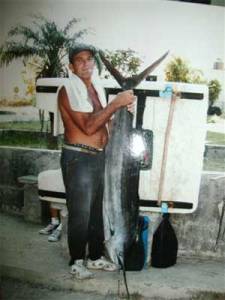
With the passage of time, a fishing culture has been forming among these individuals. In communities like Alamar, people’s knowledge about fishing using Styrofoam blocks has been established.
This is the principal circumstance that makes it so difficult for the Coast Guard to eradicate or significantly diminish this type of fishing.
The Cuban government doesn’t accept citizens freely accessing the riches of the sea. They do not tolerate people engaged in this practice of “autogestion” (self-managed initiative from below) for family survival, since at the same time the state is responsible for the country’s precarious seafood market.
While I was visiting some friends in Alamar a few days ago, I saw from afar and from the ninth floor window, an array of lights that looked more like an alien invasion.
Julito, who was right behind me, explained that these lights were luminescent buoys used by the fishermen of the neighborhood to attract mackerel, a fish prized in contemporary Cuban culinary culture.
 I was bowled over when after a few minutes, out of nowhere, there came a huge flares that overshadowed the luminous buoys. I asked Julito if that was a way of catching large fish.
Baffled as I watched the show, Julito shouted to his mother who was in the kitchen washing the dishes:
“Mama! This guy is lucky as hell” — talking about me — “He ate the last fillet that we’re gonna see in this house for a long time.”
It was mackerel.
Whilst i understand Rob’s comment, unless fisheries are manged sustainably nobody will be able to benefit from them. There are fewer and fewer fish in the sea.
it would be somewhat understandable if the cuban govt were concerned with overfishing of these waters, but i think its safe to say that the authorities are acting in this manner for on simple reason: because they can.
fishing, especially for cubans, can and does provide tasty nourishment, as well as the possibility of procuring a small income for those who catch enough to sell. the cuban regime doesn’t even hide the fact that they are, on principle, oppsosed to the concept of profit, as well as the concept of ‘self’. such a shame, such a waste.
even more important than the monetary benefits of fishing, in my opinion, is the fact that fishing is just plain fun. i am fortunate enough to live on a lake, connected to the mississipi, and i am out fishing everyday, just for the joy if it, regardless of whether or not i catch anything. if authorites pulled up and fucking burned my boat, i would be very tempted to pile-drive my anchor into their knees. more than likely i would just file a lawsuit, which the cubans have no such luxury.
hemingway wrote “The Old Man and the Sea” interesting to reflect on the fact that in modern day cuba, that gentle old mans bout would be sank, and he would probably be arrested.
Great article. When I visit Cuba, I usually stay in a casa particular located on the Malecon. Every morning when I can manage to get up early enough, I wil see these fishermen coming back from having spent virtually all night fishing just offshore for a night’s catch of 10-12 fish. With a thermos of hot coffee in hand, I will offer these guys coffee and invariably, they would give me a couple of fish. It is such a shame that the regime is so fearful of individual initiative of any sort. I found these fisherman to be of an independent sort just doing what they can do to survive.