
Cars, Cubans and Parasites
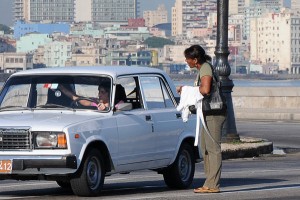
HAVANA TIMES — In Cuba, there are two ways of doing things: the easy way and the bureaucratic way. No matter how positive a law might be, the bureaucrats will always find a way to transform it into an all-consuming bog, one from which you can only escape with their assistance – which of course is never disinterested.
Last year the government approved the selling of cars, but it established three categories of citizens: those who are entitled to purchase a brand new vehicle, others who can only aim to pick up a used one from a rental company, and those who will only be able to buy one from another Cuban individual.
A trumpeter for a salsa group is entitled to buy a new car, but a campesino who works all day under the blazing tropical sun can only buy an old car from another Cuban. The same thing happens with doctors, though in their cases they’ve earned their dollars by saving lives in the African bush.
With the network of prohibitions that was established, one didn’t have to be Nostradamus to guess that some bureaucrats were going to engage in parallel business activities. The government created a captive market saying it would issue more than 2,000 letters authorizing the purchase of modern used cars.
The problem arose because they only put up 20 of those vehicles for purchase weekly. This reminded me of a Cuban psychologist who spoke on TV about the chaos caused by “the politics of the funnel,” referring to supermarkets where there are 10 checkout registers and a single exit door.
It’s not uncommon for there to appear endless lines when the authorities create a demand that is tens of times greater than the supply. Whoever has the last turn in the line today will be able to buy their car in the middle of 2014, provided that no one cuts in front of them over the next two years.
If that wait was in person — like at the bakery or the corner store — a line extending seven blocks would be formed. That calculation doesn’t have to be scientifically rigorous; it can be made on the basis of citizens’ average corporal volume, which occupies no more than 50 cm in any line.
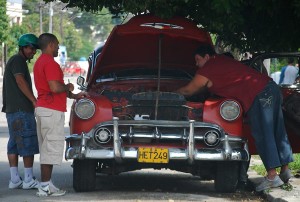
Notwithstanding, you needn’t get discouraged, the bureaucrats are there to pluck you out of the mire. If you want to buy a “demobilized” rental-company car more quickly, you simply have to reward the employee who — “at great personal risk” — will facilitate the transaction.
The rates are very flexible, depending on the resources of the “client” and the price of the car. But in the selling of a car, where I was present only by chance, I observed that the “thanks” expressed to the attentive state employee took the form of $500 (USD).
Taking that figure as the average, I multiplied it by the number of cars sold each week and discovered that these people are pocketing more than $40,000 (USD) a month, not an insignificant bonus, even if they have to split it with their bosses and other fellow workers.
The bad part is that this money doesn’t come from the pocket of some millionaire or a few wealthy individuals. It comes from ordinary Cubans who worked outside the country, away from their families, reducing their expenses to the bare minimum to save every penny to acquire the “carrito” of their dreams.
In this case, corruption is facilitated by the government itself in its attempt to exercise control over citizens around issues that should be left to each individual. Paradoxically, it’s at those moments when people come up with the best mechanisms to avoid scrutiny.
The reality is that the “state” is an abstraction that is represented in concrete practice by functionaries of varying ranks, abilities and ethics. Without a doubt some of them are among the truly virtuous, but I know others who would sell their grandmother if they could succeed at getting a good “commission.”
It’s true that we can’t live without them, but we have the possibility of clipping their wings and limiting their discretion and power to decide about the lives of average citizens. Of course this can only be achieved if the state institutions are also willing to relax their control over society.
For non-Cubans it’s almost impossible to understand the state-citizen-car relationship, but I can sense that it’s a very sensitive issue, so much so that it cost the position of a minister when he wanted to renew the stock of autos by allowing the importation of modern cars that would be traded for older ones.
It’s a mystery when one contrasts the amplitude of the law allowing the sale of houses to the prohibitions that remain on cars. Vehicles continue to be a kind of prize reserved for the select few, and undoubtedly cars have become the hallmark of the most visible class that exists in Cuba.
It would be interesting to hear the explanation about what economic, ideological, political or security problems would result if they eliminated restrictions on the trade of automobiles and allowed citizens to buy their carrito without having to be bled dry by the employee-parasites of the state.
—–
(*) An authorized translation by Havana Times (from the Spanish original) published by BBC Mundo.
Depends on who you think the bystander is and who you think you are John. Cubans are so accustomed to side deals that there is an assumption that unless you are State Security, you won’t tell on me because you do the same thing. I am an American, but everyone says I look Cuban. I saw so much “under the table” exchanges that I stopped being surprised. You are right about car prices going up even higher than they already are. By my estimates a 2-year old Hyundai in Cuba costs at least 150% of what it costs in California and my State adds a bunch of add-on taxes that Cuba does not have.
Perhaps I am missing something, but the problem seems to be that Cuba does not manufacture cars; they all have to be purchased from abroad, in convertable currency. If Cuba allowed every person who wants a car, to purchase an imported car, then it would contribute towards an unaffordable trade deficit or alternatively, if no extra cars are imported then the price of used cars would inflate to a level only affordable to the 2,000 richest Cubans: this of course would raise the most money for the Cuban government, but maybe there is some ideological resistance to allowing those sort of market forces to take over?
On the question of bribes; I think the person giving the $500 bribe and the person receiving it, were both pretty stupid if they allowed a bystander to witness it; this would be a crime anywhere in the world, but I think it would be especially punished in Cuba.
If every Cuban who could afford to buy a car was able to buy that car when they wanted to as exists in the rest of the ENTIRE world, Cuba would face several survivable but crushing shocks to the system. One, fuel availability. The President, last year, asked that the future of Cuban farming must return to, at least in part, oxen and plow due to limited fuel. Two, increased traffic. In Havana, the physical condition of the main thoroughfares, let alone the secondary streets, is so bad in most places that with more traffic it would be a disaster. As it is, traffic flows are oftne interrupted to avoid huge potholes. Finally, three, further isolation and separation of the lower class from the middle and upper economic classes. Most Cubans already know whether they areeconomically upper, middle and lower class. Still, the lines separating them are not nearly as visible as they are in other countries. Add more cars to the mix and poor people will feel really poor. These three shocks and, of course, there are others would have measurable reverberations socially and politically as well. I live in San Francisco. To house and drive a car in my city is very expensive and intentionally so. There is a limited supply of car space and demand for that space is high. Prices rise. Because the State controls prices in Cuba, other less civilized factors would regulate the demand on car resources.