
The (Non) Right of Cubans to Travel
Haroldo Dilla Alfonso
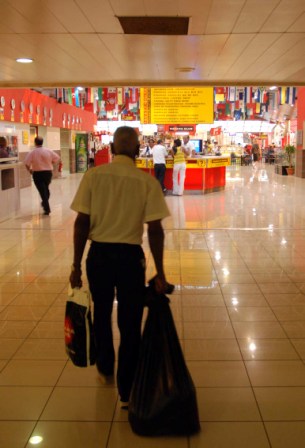
HAVANA TIMES, Feb. 1 — A while ago, Cuban Parliament President Ricardo Alarcon was asked whether Cubans should be entitled the right to travel freely. This prominent member of the island’s political elite responded —in the finest style of standup comedy— saying that if this right existed, the sky would become so filled with airplanes that some would collide with others, causing great a disaster. In my opinion, the greater disaster was this official’s response.
This statement was probably no more disastrous than what was later said by the president of the Cuban National Union of Writers and Artists (UNEAC), writer Miguel Barnet. He affirmed that in Cuba there exists complete freedom to travel, citing as an example the fact that he himself has traveled to thirty countries. As I suspect he hopes to continue traveling, Barnet knows he must walk a thin line, otherwise he risks discrediting himself and seeing the end of his journeys.
Such collusion extends to a good part of the Cuban intellectual camp, including many “progressives” and “reformists” whose critical poses are so well-liked by foreign correspondents here in Havana.
A few weeks ago, a distinguished Cuban intellectual who resides in New York wrote to me disappointed by a well-known and active “verbal reformist” —a comrade of days gone by— who spent several minutes at a forum in Pittsburgh explaining that the only obstacle that his fellow Cubans face in traveling is obtaining a visa from the destination country.
Sometimes this matter is not mentioned so directly in self-rewarding displays of immodesty, as those of Barnet and the old friend; rather, they divert their sights, focusing insistently on the US side without distinguishing anything else around them. It’s as if an epidemic of political pigmentary retinopathy has broken out on the island.
The Cuban intellectual world reacts in convulsions every time a travel visa to the United States is refused for a personality in Cuba – as happened with Silvio Rodriguez at the beginning of the Obama administration. Similar responses result with the annual rejection of demands by the Cuban members of the Latin American Studies Association (within which there are many Cubans from the island, both reformists and hardliners); that advocates the US government grant greater freedom for American academics to travel to Cuba. These are only a couple examples of this hypocritical collusion.
The situation in Cuba concerning the freedom to travel is unfortunate. What I’m describing here is not for Cuban readers (who are all too familiar with this issue), but for those who are unaware of the matter and are forced to accept the information of those who close their eyes to this flagrant civil rights violation, a veritable wedge driven between the Cuban nation made up of both émigrés and those residing on the island.
Above all, travel for Cubans is not a right, but a legal privilege. It is a condition that can be granted or rescinded. It is a revocable concession by an unappealable power and is without a defined judicial framework.
In Cuba there are three ways to travel abroad:
1 – as someone holding an exceptional status, with which they can enter and leave almost freely at whatever moment they consider it necessary. This is granted to some people (but not all) who have married foreigners and to prominent members of the political and intellectual elite or their family members. This would almost be a normal status if it didn’t have to be negotiated and if it weren’t revocable should the person demonstrate some type of political behavior unacceptable to the government. Very few people are in this stratum.
2 – as someone who is leaving on an official assignment (officials, academics, artists and technicians). These individuals require an official institution to authorize and sponsor their trip, and in each case the person’s passport must be revalidated by Cuban authorities for each trip abroad. If the person who leaves on one of these trips decides not to return to Cuba —if they “desert”— they then lose all rights of citizenship and cannot return to the country for several years (up to five); nor are their family members allowed to leave the island, which means the family is condemned to several years of separation. Needless to say, if some academic demonstrates themselves to be particularly critical while on their trip, it’s possible that they will not see the inside of international airport terminal for quite some time.
3 – as someone going on a private trip, of which there are two categories. The first category, opaque for most earthlings, is the “definitive” exit; meaning the person is emigrating and cannot return to live in Cuba. With this they lose all of their rights and property on the island.
The second category includes people who plan to travel only temporarily. They may remain outside the island for up to 11 months, after which time they must return or else they become “definitive migrants.” In all cases the departure by such individuals must be specifically authorized by the Ministry of the Interior and by the institution where that person last worked.
Other categories of technicians exist —for doctors, for example— who cannot leave through this channel. Likewise, there is a category for people considered “politically adverse,” for which the obstacles to exit are numerous.
The most dramatic case of denying the right to travel was that of Hilda Molina. By then an elderly scientist, she had previously broken with the official party machine —to which she had once passionately adhered— and therefore her reunion with all of her family living in Argentina was denied for years, until the Cuban government finally conceded to a petition by Buenos Aires.
What is particularly negative is that people who want to travel temporarily cannot take their children (those below legal age). This is only possible when the person decides to emigrate “definitively.”

In all cases, the departures of these people imply considerable fees that can end up in well excess of US $500, an immense sum for a population with exceedingly depressed wages that average $20 a month. In short, to leave, each person must be able to pay for a letter of invitation, a passport and an exit permit.
On top of this, once in the destination country, the traveler must make payments to the Cuban embassy in that country a sum that varies each month they remain in that country, which is a highly uncustomary practice. This sum fluctuates between $40 and $150 a month.
Deciding to live abroad
I have not been exhaustive in the preceding account because I prefer to proceed to briefly explain what happens when a person decides to reside in a foreign country (those apart from the very small minority that has been authorized to do so).
As noted, this person loses all of their property and rights in Cuba, which technically makes them an exile. If at some time they wish to return, they can do so only as a visitor. For this they must be specifically authorized by the government through a stamp that is placed in their passport and authorizes them to stay for 21 days.
Many Cubans are not authorized, not even in cases of family emergencies. There exist groups of émigrés —the case of most of the 1994 “balseros” (boat people) — who face special difficulties in obtaining entry permits. Others are authorized but are turned back once they land on Cuban soil.
They can only travel to the island under a Cuban passport, their current citizenship doesn’t matter; moreover, their citizenship must be renewed every two years at a cost of one hundred dollars.
The logical upshot is that Cuban émigrés live in legal limbo, since the Cuban government does not accept “returnees,” and because of that they are undesirable in many places. A tragicomic example was that of a Cuban who had to spend 50 days in San Jose’s airport because he could neither enter Costa Rica nor return to Cuba – like what happened to Tom Hanks in his outstanding movie “The Terminal,” though without the prize of Catherine Zeta Jones. Here, as Oscar Wilde once said, life imitated art.
There are no laws or clearly written regulations covering these processes; rather, there are arbitrary and discretionary practices that mix starkly fascist reins of political control with mercurial motivations of the worst kind. In this way, the Cuban government denies a right that it alternately sells to those who can afford it.
Cubans who travel abroad must behave with “political correctness” if they want to continue traveling, if they want see their loved ones again or if they want to one day return to Cuba – to the place where they were born, to feel fully Cuban. That right has been expropriated by an authoritarian and repressive political elite that has —one by one— denied the values and the human goals of the revolution and socialism.
But we must pay them, and pay them well, so they can continue reproducing their power with the same parasitic style they’ve displayed over the last fifty years.
I’m sure that in the case of Cuban emigrants, we are faced with a situation of the uppercase violation of the rights of people and one which is the source of much human suffering.
Only for this reason it is worth our trouble to look into this matter and to begin to move in that direction. We must even lend assistance to people like Miguel Barnet and the friend of days gone by, so they are not forced to stoop to such ignoble positions in the face of the brutish legal scaffold that the Cuban government has erected before them.
…simply so Cuba becomes better.
My brother suggested I would possibly like this blog.
He was once entirely right. This publish actually made my day.
You can not consider just how so much time I had spent for this information! Thank
you!
My mom is Cuban, yet when she got married to my dad, she was allowed to leave even though my dad was also a Cuban, but he had escaped cuba when he was younger, because his dad had tried to leave also, but then he was put in jail for one week. Then, they waited a while till my dad was around the age of 9, they went to the airport, and bribed the officer so they can leave Cuba. The officer approved of the money and allowed them to leave. My dad went back to Cuba in his 30’s then met my mom. He then got married, and moved to America with my mom, who had to leave everything. Her parents, and sisters, who now live in America.
That’s why my grandpa can’t leave Cuba! It breaks my heart, because I haven’t seen him in 6 years! I’m 11 right now! I just wish they could change the law, so that my grandpa would finally be able to go to America. He only gotten visa to travel to Toronto, but then we went to go see Niagara Falls (which is like 3 hours away), and we passed the boarder. But we only passed the boarder for 1 hour. My grandpa is very old in age. His b-day is on the 7th, and he’s turning 72. My grandma died before she could even experience America. I literally had a dream that she died and took off all her casts, and went to heaven (she was a Christian for 30 years cuz my mom talked about Jesus to her two older sisters and mom), and when I asked my mom if it was true, she told me that she had just gotten off the phone with her sisters, and said that it was true. I was 6 at that time and I had a vision! Amazing things that God does with your life.
Not that I’ve ever heard of. Wherever the flight leaves from which is usually Terminal 3 for Canada.
My Cuban (I am Canadian)wife of two years has all required documentation to immigrate to Canada. Are there any restrictions on which airport or airline used to leave Cuba?
Here is a thought….
If ALL countries had open borders then governements would be forced to be more efficcient and more caring, or people would simply not live and pay taxes there. Yje countries with the best social and economic climates would prevail, and those that opress citizens and waste would have only those who could not leave for economic reasons.
I see that as the only way to force governments from brainwashing and taking advantage citizens.
This is no longer true Mr Anderson. The USA and Canada I believe now require a Passport for entry . Anyone of the many people now residing in a place like Mexico , and who has lived there for years , and entered without a passport, reciognizes that a premium is paid for a Passport wich at least in the USA can be DENIED withjout justification. leaving some of these folks falling throuigh the cracksm and unable to retuirn to their birth country. . They can not even board a plane without a Passport.
There are Caribbean countries English speaking,
that would allow your husband to enter, St. Vincent, St Lucia, Jamaica
I am in the process of helping my boyfriend to leave also.
Is there any update on this situation following the Party Congress?
Well researched – well written (though I realize it was posted more than a year ago)!
Having just returned from cuba (I lived there for the past 3 months to initiate a preventive health-care work project), I have personally experienced discretionary decisions made by cuban officials, many of whom didn’t know their own constitution or legal code (I purchased a copy while I was there so I could better understand). Mine were not related to travel though, I should clarify.
It’s intriguing to read so many comments with so many varied opinions…. as is so often the case, each situation is different. The article is general enough to cover many differences. The only opinion I had a problem with is that of Glen Roberts (I know of many Cubans who were jailed in their own country for far less than possessing a dollar bill… you are wrong Sir) …. you have a lot to learn about how cubans are suffering now in cuba (and I am referring mostly to the Oriente…. Havana is very different from the rest of the country). Many people are living in fear every day that they won’t be able to feed themselves or their families next month or even next week…. and this is a reality. My opinion – the economic inequity between cuba and the ‘rest-of-the-world’ along with that country’s political paranoia is a Cuban’s greatest obstacle to travel.
The bottom line is that the Cubans have to get a permission granted by the communist regime to leave (The White Card) Cuba and pay heavy sum of money (every month) to the Cuban regime while abroad to be able to come back. Also they are closely monitored by supervisors (secret police). Cubans that have settled in other countries are not allowed to move back to Cuba unless you were in a “mission” authorized by the regime. All ex communist countries of the soviet block including Russia suffered the same way until the fall of the Berlin Wall. That is the difference between Cuba and the rest of the countries where its citizens are free to come and go as they wish. Cubans are not even free to move from one province to another !
Hi John Goodrich, partially agree with you partially not. The Freedom of Opinion and Speech is one of the biggest values within Socialist Democracy.Revolutions were not made for makuing people shut up. Or like Bertold Brecht once said: If the party doesn`t like the people, they should look for other people. The Right to Travel freely has as least to be accorded to everybody, as one of the basis democratic rights.. Whether in praxis you can execute it or not, that`s another question, it`s simpy a question of money.
One point mentioned in the article above is absolutely true: the problem is not so much getting out of Cuba, the problem is rather the other countries. not letting Cubans in. Being from Austria, so European Citzen, I know what I´m talking about. Therefore allso some of the other lectors: please, don`t always blame Cuba, make rather the intolerant and often inhuman Immigration Rules of many countries responsible for the misery..
Kind regars from Vienna/Austria
Companeros,
There is (or used to be) a billboard in Cuba that read:
In the world today millions of children sleep in the streets.
NOT ONE IS CUBAN.
In those countries of the world where everyone is free to travel, millions starve to death and they’re lucky if they can crawl, never mind travel abroad.
In those countries and in the United States everyone is free to say what they want UNTIL what you say becomes a threat to the status quo and then you are silenced.
What good is freedom to travel or freedom of speech if you have nothing to feed your children? If all you’re allowed to say must be of no possible use in changing things?
What good is freedom when you’ve lost your home, when you’re a refugee from poverty?
It is better to live simply so that others may simply live.
The U.S war on Cuba will eventually end. When that happens and Cuba can develop its socialism and democracy can develop without interference, then every Cuban should demand the freedom to travel, the freedom to say what one wants but until then Cubans have the responsibility to maintain unity in the face of the unremitting U.S drive to destroy Cuba’s revolution.
I am not saying don’t complain and do not plan for that day when the war ends by pointing out what can be changed and how that can be accomplished but please be aware that every harsh criticism of the revolution is working in the interests of the U.S.
You cannot lose sight of the fact that there is a war against you being waged by the most dangerous of enemies.
The whole world IS watching and listening to you Cubans.
The hopes for the future for universal democratic socialism rest with what you do and say.
The poor of the world need the Cuban revolution to be a success that no one can deny.
We must all work toward that end.
What i always find striking in Western discussions of Cuba is the total absence of any relative basis of comparison. Cuba HAS problems. I sense the anger and the frustration. What I do NOT see, however, are some of the sights available to anyone who can travel to Central America: the hungry children with swollen bellies in the countryside, the swarms of street kids trying to sell you papers or gum late at night, the campesinos who don’t know what a doctor looks like. Comparing Cuba with Switzerland is idiocy. Try comparing it with what is comparable.
The Castro brothers’ regime systematically denies the right of Cubans to travel freely. This is only one of many rights denied to them. Cubans can’t legally leave or reenter the country without regime authorization. Cubans who apply to emigrate lose their belongings and homes. Those who fail to escape illegally are sent to prison.
Well, I have gone thru all the oddities to finally arrive first in EU and later to Canada. Fee-wise and paper-work wise the smallest effort was to leave Cuba – the biggest and most insulting effort to enter the E.U. and later Canada. All migratory rules are very costly and degrading. Cuba is not good at this but the migratory regimes of the *free* world are not even slightly better, they even accept people dying trying to enter. Its very valid to criticize Cuba here, but then tell the whole migratory story, and get rid of the brainwashing propaganda you carry around unreflected.
I just want to live in the same country with my Cuban husband. Canada won’t let him come here yet, so we are going to try to live together in Ecuador. I still don’t know how I will get him invited there (by an Ecuadorian resident) nor if the Cuban government will let him go to live with me… I’d really rather not live in Cuba. In my experience, it is rather repressive and lacking in the daily essentials we Canadians take for granted!
Please tell me what countries my husband can freely fly through to join me in Ecuador… if we actually get that far. Can he go through Mexico or Costa Rica? How would I get him a transit visa?
Please help!
Brenda
Most Cubans and the average Cuban would not qualify for a visa to a first world country, regardless of what the Cuban governments policy states.
For those non cuban that share the idea that the cuban can leave the country freely, I answer, I am cuban and can asure that every thing writed in that article is the real truth. How in the worl can you compare the status of the US citizen that cant visit Cuba and the cuban that need the goverment permit to go anywere in the word (and pay for that permit). Once I leave the country was that I relly knew the freedon to travel.
Mary
I agree with Glen, Havana has got its priorities right – young people everywhere want to travel the world, but even in the wealthy countries this is an economic privilege, or a fringe benefit of work. Cubans professionals get this fringe benefit through the international missions. For the others, it’s not so easy.
Great article. Tells the real plight of Cubans who wish to travel and couldn’t because of archaic and superfluous regulations.
If Cubans are not allowed to travel then who rides on Cuban Airlines that fly to 8 to 14 places with 14 to 20 planes travlling all the time???……..I have friends working in both France and Germany…they had no trouble to leave but Canadian Goverment and US do not give visas but say Cubans not allowed to leave…LIES,,,
I know of a Cuban who applied for a five year passport and was granted it by Cuba. The Cuban Ministry of Education – the employer, gave a letter of permission for the period of intended travel to Canada. The intending host provided a letter of invitation covering all costs, plus a statement from their bank giving financial details, plus a statutory declaration counter signed by a Notary Public stating that the host would cover all expenses including any medical costs and that no claim would be made upon any government services in the host country. A visa application was made to the intended host country Embassy in Havana. It was denied on the grounds that the applicant did not have sufficient wealth in Cuba to make them return. So who is restricting the right of Cubans to travel? WE ARE! I live in Canada, part of the “free” world
Flavia, I may’ve met more kinds of Cubans and seen more of Cuba than you, and if it were as bad as you say, I’d see it. But I don’t. Haroldo IS exaggerating and twisting facts and so are you. No Cuban’s been jailed JUST for having a $1 bill. You’re omitting something. Cubans AREN’T paid $20 a month. Thanks to the leaders Haroldo keeps stabbing with his pen, by participating in their system, they earn their homes, transit, recreation and all they need to live clean, healthy, dignified lives plus a monthly stipend in pesos worth more than dollars are worth in Miami. Protected from real suffering, HT writers lack perspective and whine a lot, which would be OK if they’d put it in honest context and sometimes support their very important revolution.
Excuse me but are all Americans allowed to travel freely to Cuba.The land of the free and the home of the brave seems to have a double standard when it comes to Cuba.
To Glen Roberts: Sir, with all due respect, living in Chiapas and knowing a few Cubans does not amount to know what happens in Cuba. Knowing that requires that you live in Cuba and besides, that you are Cuban. Forgive me, but that is the only way.
Actually this article is very accurate and I hope many people read it so the world finally gets how a Cuban feels when he starts contemplating the option of traveling abroad or emigrating.
To Glen Roberts: Sir, I can swear the person who wrote this article is not exaggerating at all. In fact, just a few years ago, back in the eighties, it was way worse. After the foreign currencies were allowed to be used ( it could cost upto 8 years in prison to be caught with a dollar bill) in 1993, one could say that fredom came at last to the Cuban people, if compared to the previous years. So poor was the scene concerning civil and political human rights. It is hard to believe because we take it for grant it here in the USA and many other countries-although the chances to exercise these liberties depend greatly on one’s personal finacial situation. In that sense, Ricardo Alarcon could have chosen a better way to express that basically right idea. Everybody is allowed to travel provided that he/she has the money and the time. As for the one who demands the opening of the European borders, are we talking here about touring a country or go to live there?
The entire wentern world deny the peoples of Africa, Asia and Latin america to travel freely. Why is hundreds of refugees dying each months because they are forbidden to enter Europe?
First in a world that allawa ALL peoples in the world to travel freely – then we can speak of Cuba.
So please Europe OPEN ALL BORDERS !!!! For all asians, all africans and all latinamerican people!!!
When I lived in San Cristobal de las Casas in Mexico, I knew several Cubans living there who came and went freely since they were married to Mexicans. Whether militants or dissidents, none mentioned the kind of hassle you cite under 1 above. In Cuba, I know an artist and an academic who visited the US for reasons sort of like what you describe under 2 above. But since neither had any idea of not going home, most of your diatribe is irrelevant to their cases. I’ve also met a number of Cubans, including one very good friend, who visited relatives abroad, but, again, since they just made normal one or two month visits, most of what you say couldn’t have applied to them. It happens to be true that other countries, to grant a visa, require Cubans to have enough dollars saved, a host able to pay their way, someone there to marry them, or a job waiting. I think you’re exaggerating. I’ve posted an open letter to HT on my website, iammyownreporter.com that I think you should read.
It seems there is scope for a huge deal there.
The USA can end restrictions on US citizens and residents who wish to travel to Cuba in return for Cuba similarly ending restrictions on Cuban citizens and residents who wish to travel to the USA.
And of course both countries retain the right to refuse to admit any and all undesirables.
Wouldn’t that allow both sides to have a win-win situation?
I hope your government could understand that not allowing to its intelligentsia freely travel and emigrate abroad is a harm for Cuba, because it creates positive imagination of foreign countries in comparison to Cuba. Let them go and try find themselves oversees, most of them soon after departure will realize that Cuba is only friendly place to them. As many former USSR citizens realized today, after 20 years of living under “DEMOnoCratic regimes, which care only on how much they can get for themselves from ordinary citizens… There all countries in ruins. We use to wanted all these freedoms… Give us socialism back!!!
Congratulations! Irt is a great and smart post
Cuba remains one of the very few Countries in the World where it’s Citizens must obtain(and Pay for) a “permiso” to re-enter the Land of their Birth.. This is a manner of control and a good source of revenue as well. But highly Uncivilized.
Horror.
Where has Communism or Marxism ever bred real freedom?